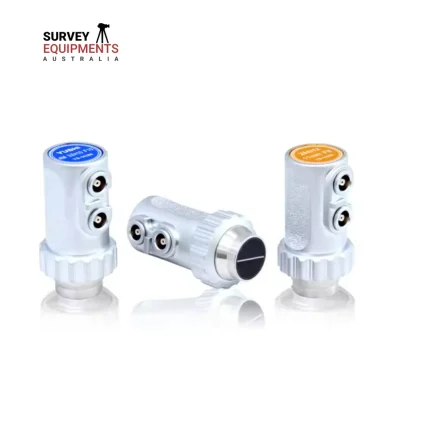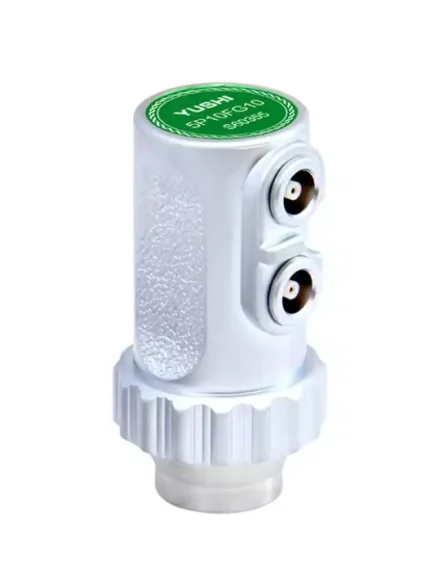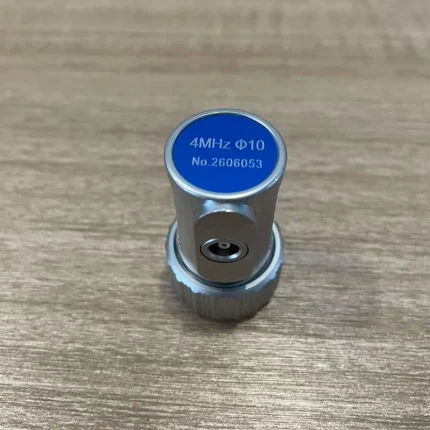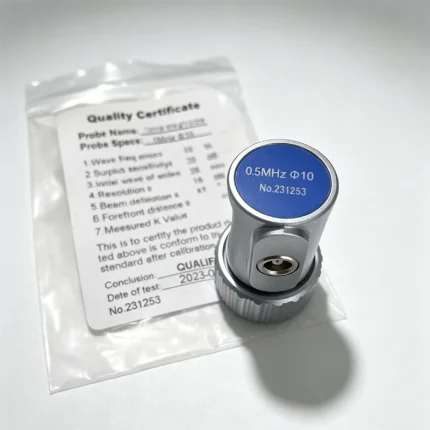


The Olympus Style TOFD Transducer is a single-element ultrasonic probe engineered to generate refracted longitudinal waves in steel, enabling precise crack sizing and flaw detection through the Time-of-Flight Diffraction (TOFD) method.
Built with a highly damped composite element, this transducer delivers broadband sensitivity and sharp resolution, making it a reliable choice for weld inspection, crack monitoring, and structural integrity testing in industrial and NDT (non-destructive testing) environments.
This probe features an Olympus-style housing and a microdot connector, ensuring compatibility with standard TOFD wedges and widely used ultrasonic flaw detection systems.
Key Features
- Highly Damped Composite Element delivers excellent resolution even in demanding TOFD applications
- Broadband Frequency Response supports precise diffraction signal capture across a wide frequency range
- Olympus-Style Probe Housing ensures seamless compatibility with standard TOFD wedge systems
- Microdot Connector provides a secure, industry-standard connection to ultrasonic flaw detectors
- Multiple Frequency & Crystal Size Options allows selection based on material thickness and inspection sensitivity requirements
- Probe Only sold without wedge, allowing pairing with your existing or preferred TOFD wedge
How This TOFD Transducer Works
TOFD transducers and wedges work together to generate refracted longitudinal waves that travel through steel components. As these waves encounter a crack or flaw, diffracted signals are captured and analysed to determine flaw depth, height, and position, a technique widely used for crack sizing and weld inspection in pressure vessels, pipelines, and structural steel.
Because this transducer uses a composite element with high damping characteristics, it produces cleaner, more resolvable signals than standard single-crystal probes, which is critical when distinguishing closely spaced diffraction signals in thin or complex weld geometries.
Product Specifications
Choosing the Right Frequency and Crystal Size
- Lower frequencies (2.25–5 MHz) better suited for thicker steel sections, offering deeper penetration with lower resolution
- Higher frequencies (10–15 MHz) ideal for thinner materials and applications requiring finer resolution and more precise flaw sizing
- Larger crystal sizes (6–12 mm) improve signal strength and are often used in general-purpose TOFD scanning
- Smaller crystal sizes (3 mm) support tighter beam focus, useful in confined inspection zones or higher-frequency setups
Common Applications
- Weld seam inspection in pressure vessels and pipelines
- Crack sizing and depth measurement in steel structures
- In-service inspection of structural steel components
- Manufacturing quality control for critical steel assemblies
- Petrochemical, power generation, and heavy fabrication industries
Frequently Asked Questions
What is a TOFD transducer used for?
A TOFD transducer generates refracted longitudinal waves used to detect and size cracks in steel, primarily for weld inspection and structural flaw evaluation using the Time-of-Flight Diffraction technique.
Does this transducer include the wedge?
No. This listing includes the probe only. A compatible TOFD wedge is required separately to generate the refracted longitudinal wave angle needed for testing.
What connector type does this probe use?
This transducer uses a microdot connector, a standard connection type compatible with common ultrasonic flaw detection instruments.
What frequency range is available for this TOFD probe?
This TOFD transducer series is available in frequencies ranging from 2.25 MHz to 15 MHz, allowing selection based on material thickness and required resolution.
Is this transducer compatible with Olympus TOFD systems?
Yes. The probe housing follows the Olympus-style design, making it compatible with standard Olympus-style TOFD wedges and holders.
What crystal sizes are offered?
Crystal sizes range from 3 mm to 12 mm, depending on the selected frequency and inspection requirement.