


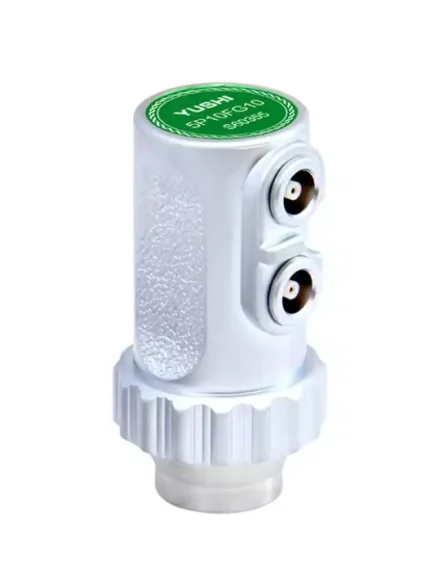
The 8×9mm ultrasonic angle beam probe is an NDT ultrasonic transducer designed for ultrasonic flaw detection and angle-beam testing. It features an 8×9mm element size, selectable 2MHz or 4MHz frequency, and 45°, 60°, or 70° beam angles, with a LEMO 00 connector for connection to compatible ultrasonic flaw detectors.
This ultrasonic angle probe is available in six configurations, allowing inspectors to select the appropriate frequency and refracted beam angle for their ultrasonic testing requirements.
Technical Specifications
| Specification | Details |
| Product Type | Ultrasonic Angle Beam Probe |
| Application | Ultrasonic Flaw Detection / NDT UT Inspection |
| Element Size | 8×9mm |
| Frequency Options | 2MHz / 4MHz |
| Beam Angle Options | 45° / 60° / 70° |
| Connector | LEMO 00 |
| 2MHz Models | 2P8×9A45° / 2P8×9A60° / 2P8×9A70° |
| 4MHz Models | 4P8×9A45° / 4P8×9A60° / 4P8×9A70° |
| Quantity | MOQ 1 |
| Packaging | Carton |
Features: Ultrasonic Angle Beam Probe
- 8×9mm element size for angle-beam ultrasonic inspection
- Available in 2MHz and 4MHz frequencies
- Choose from 45°, 60°, or 70° beam angles
- LEMO 00 connector configuration
- Designed for use as an NDT ultrasonic transducer
- Suitable for ultrasonic flaw detection applications
- Six frequency-and-angle configurations available
- MOQ: 1 piece
- Supplied in carton packaging
2MHz and 4MHz Ultrasonic Probe Options
The probe is offered in two frequency groups to provide different inspection configurations.
2MHz 8×9mm Angle Beam Probe
The 2MHz version is available with three beam angles:
- 2P8×9A45°
- 2P8×9A60°
- 2P8×9A70°
4MHz 8×9mm Angle Beam Probe
The 4MHz version is also available in three beam angles:
- 4P8×9A45°
- 4P8×9A60°
- 4P8×9A70°
45°, 60°, and 70° Beam Angle Selection
Different refracted beam angles can be selected according to the inspection geometry and test procedure.
- 45° angle probe suitable for applications requiring a lower angle ultrasonic beam.
- A 60° angle probe provides an intermediate beam angle for a wide range of angle-beam inspection setups.
- A 70° angle probe is useful where a higher refracted beam angle is required.
The correct probe should be selected according to the material, component geometry, inspection standard, flaw orientation, and ultrasonic flaw detector being used.
Key Benefits
Precise Angle-Beam Inspection
The probe is designed for angle-beam ultrasonic testing, directing ultrasonic energy into the test material at a selected angle for detecting internal discontinuities.
Multiple Frequency Choices
The availability of 2MHz and 4MHz versions gives buyers flexibility when configuring an ultrasonic testing system for different inspection requirements.
Six Configuration Options
A single product range covers six combinations of frequency and beam angle:
Frequency | Beam Angle | Model |
| 2MHz | 45° | 2P8×9A45° |
| 2MHz | 60° | 2P8×9A60° |
| 2MHz | 70° | 2P8×9A70° |
| 4MHz | 45° | 4P8×9A45° |
| 4MHz | 60° | 4P8×9A60° |
| 4MHz | 70° | 4P8×9A70° |
Applications of the 8×9mm NDT Ultrasonic Probe
This NDT ultrasonic angle probe is intended for professional ultrasonic inspection applications where angle-beam transmission is required. Typical applications may include:
- Ultrasonic flaw detection
- Weld inspection
- Non-destructive testing (NDT)
- Internal discontinuity detection
- Angle-beam ultrasonic testing
- Inspection of metallic components
- Industrial quality-control inspection
- Maintenance and condition-assessment work
The actual application and inspection procedure should follow the applicable NDT standard, calibration procedure, and requirements of the ultrasonic flaw detector manufacturer.
How to Choose the Correct Probe
Select the probe according to three primary parameters:
1. Choose the Frequency
Select 2MHz or 4MHz according to the required inspection setup and test procedure.
2. Choose the Beam Angle
Select 45°, 60°, or 70° according to component geometry, expected discontinuity orientation, and the required ultrasonic beam path.
3. Verify the Connector
This product uses a LEMO 00 connector. Confirm that the connector configuration and electrical interface match your ultrasonic flaw detector before ordering.
Why Use an Angle Beam Ultrasonic Transducer?
An angle beam ultrasonic transducer introduces ultrasonic energy into the test material at an angle rather than using a straight-beam configuration. This makes angle-beam probes particularly useful for inspection procedures where the ultrasonic beam needs to travel through a component at a specific refracted angle.
The 8×9mm ultrasonic angle beam probe combines a compact element size with multiple frequency and angle options, making it suitable for different NDT ultrasonic inspection configurations.
Frequently Asked Questions
What is an 8×9mm ultrasonic angle beam probe?
An 8×9mm ultrasonic angle beam probe is an NDT ultrasonic transducer with an 8×9mm element designed to transmit an angled ultrasonic beam into a test material for flaw detection and inspection.
What frequencies are available?
The probe is available in 2MHz and 4MHz configurations.
Which beam angles are available?
You can choose between 45°, 60°, and 70° beam-angle configurations.
What are the available 2MHz models?
The 2MHz models are 2P8×9A45°, 2P8×9A60°, and 2P8×9A70°.
What are the available 4MHz models?
The 4MHz models are 4P8×9A45°, 4P8×9A60°, and 4P8×9A70°.
What connector does this ultrasonic probe use?
The supplied specification identifies the connector as LEMO 00.
Can this probe be used for ultrasonic flaw detection?
Yes. It is specified as an ultrasonic flaw detector transducer for NDT ultrasonic inspection and angle-beam testing applications.
How do I choose between 45°, 60°, and 70°?
The appropriate beam angle depends on the inspection procedure, component geometry, material, expected flaw orientation, and applicable testing standard. Choose the angle specified by your inspection procedure rather than selecting solely by angle.
How do I choose between 2MHz and 4MHz?
Frequency selection should be based on the required inspection procedure and test conditions. The 2MHz and 4MHz versions provide different frequency options within the same 8×9mm angle-probe range.




Reviews
There are no reviews yet.