



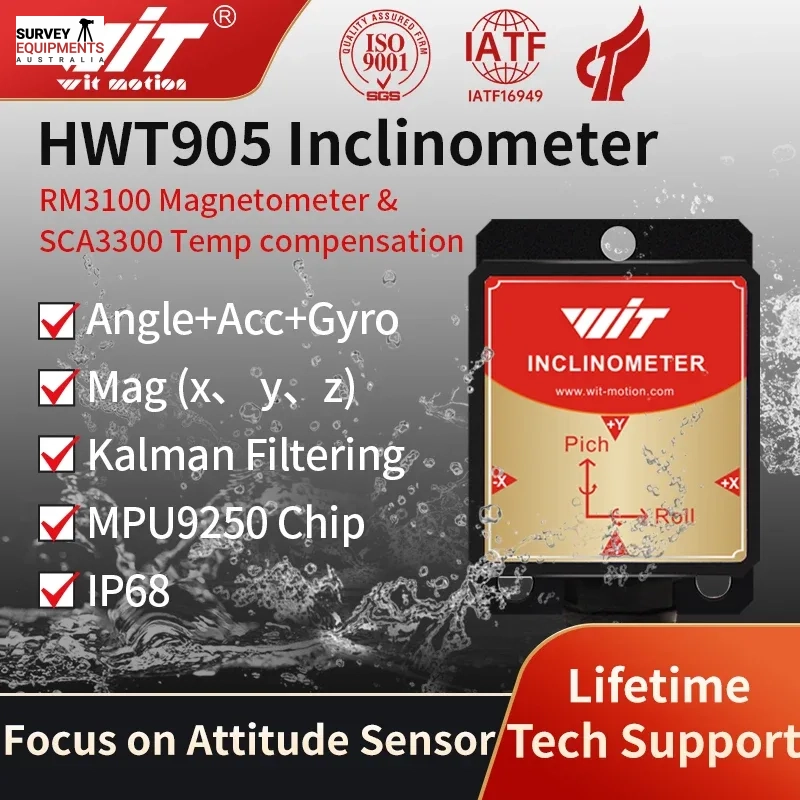
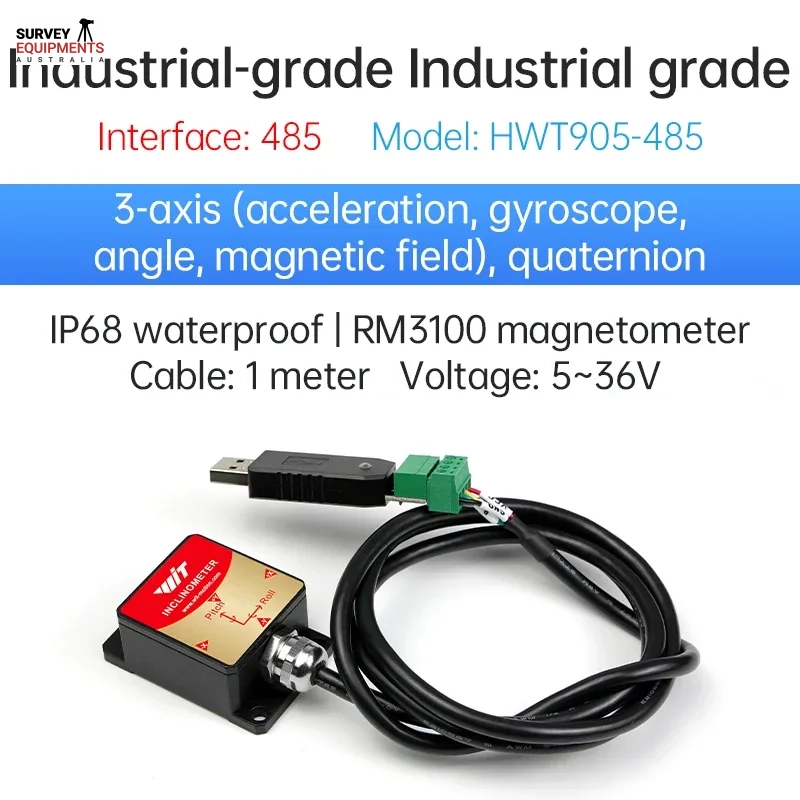
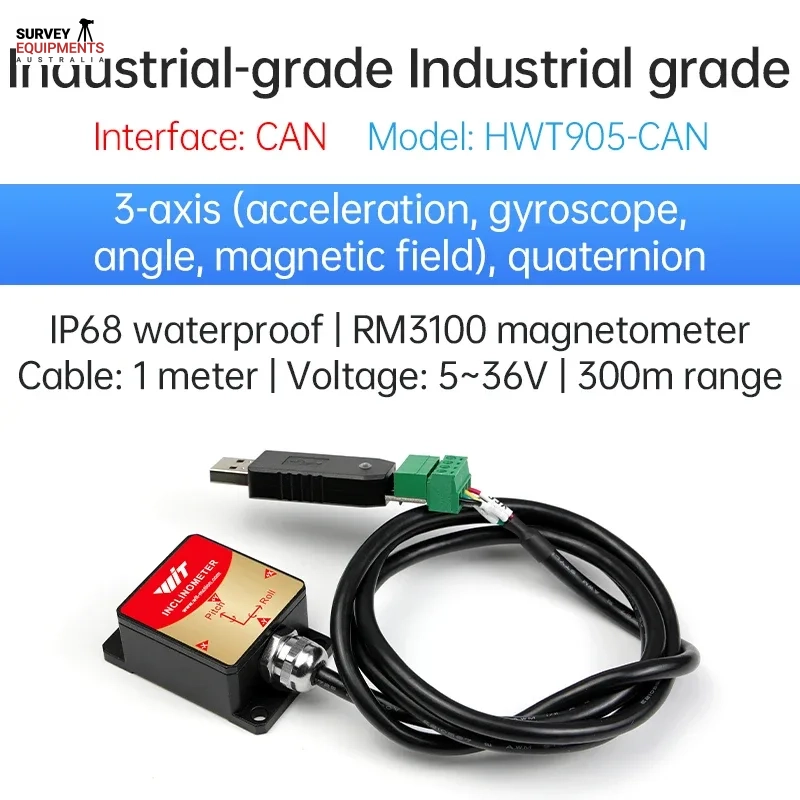
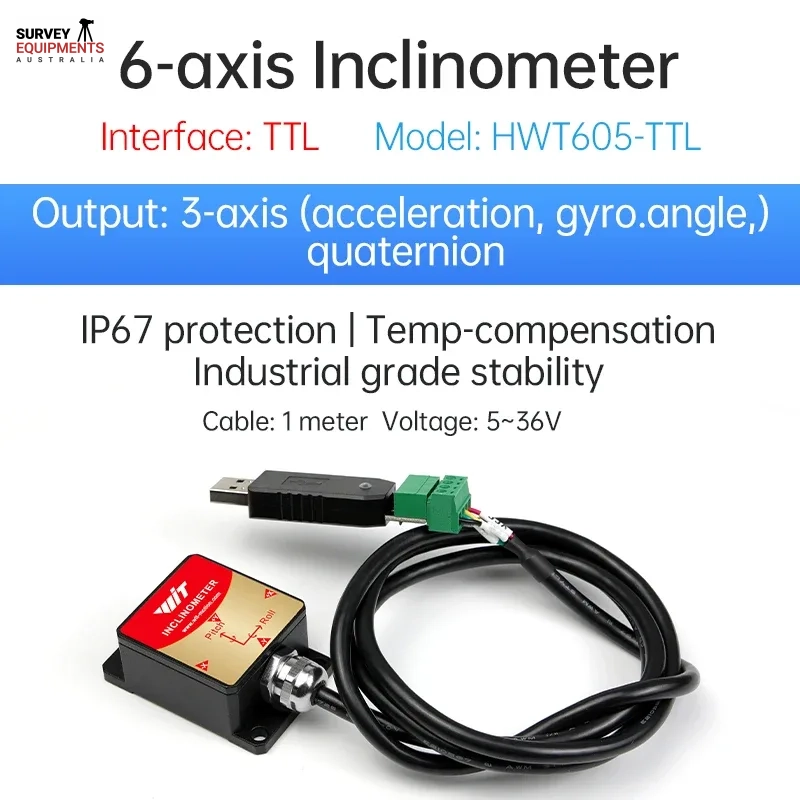
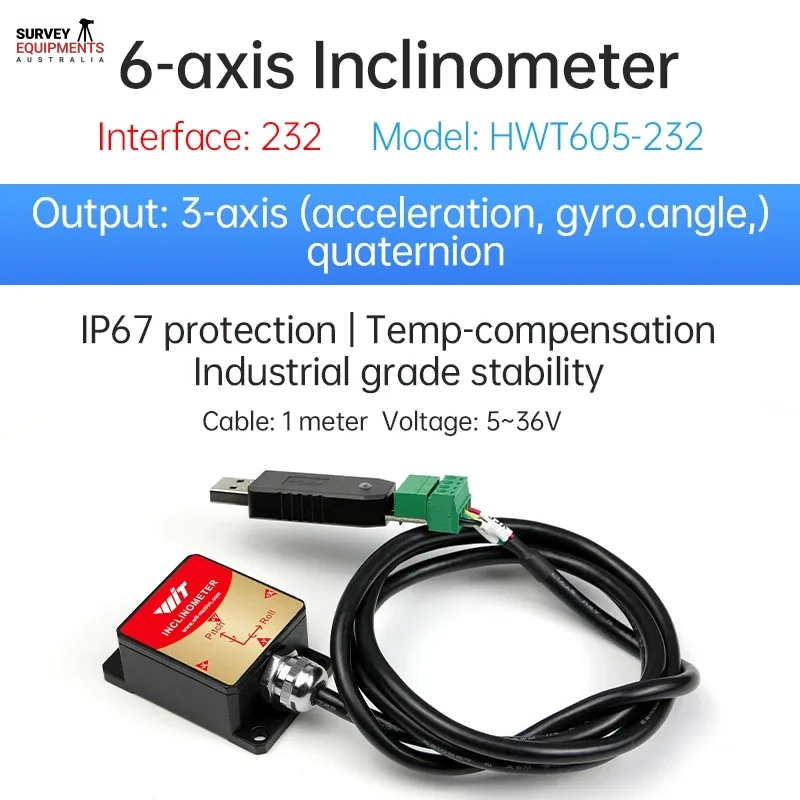

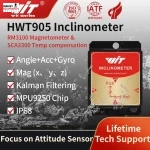









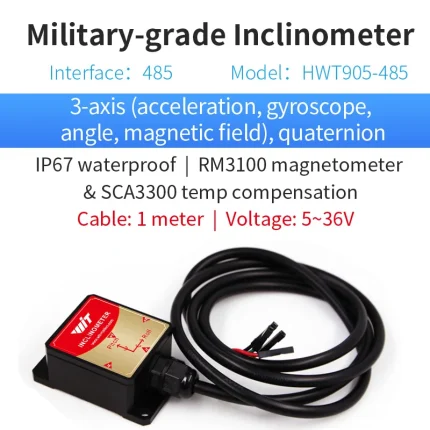
The WitMotion HWT905 inclinometer is an industrial-grade 9-axis attitude and tilt sensor that combines a 3-axis accelerometer, 3-axis gyroscope and RM3100 3-axis magnetometer in an IP67 metal housing. It outputs roll, pitch and heading angles with 0.05° accuracy on the X and Y axes and 1° on the Z axis (after calibration, without magnetic interference), at up to 200 Hz over TTL, RS232, RS485 (Modbus) or CAN.
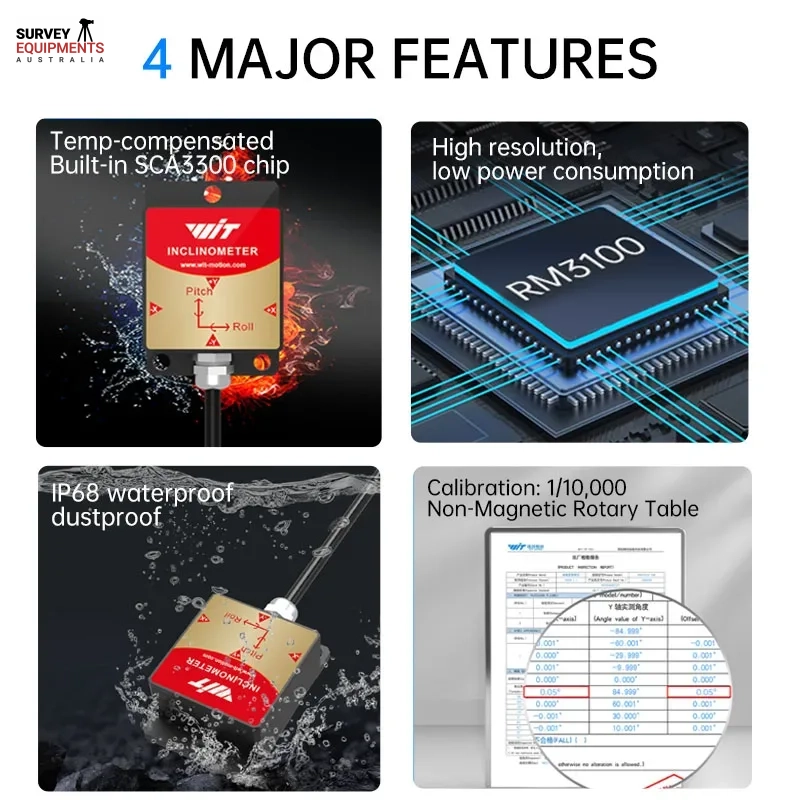
Each unit is factory calibrated on a 0.01% three-axis non-magnetic rotary table and uses SCA3300 temperature compensation with a Kalman-filter fusion algorithm, so readings stay stable from -40 °C to +85 °C in vibrating, wet and dusty field conditions.
Why Choose the HWT905 Digital Inclinometer Sensor
- 0.05° X/Y tilt accuracy : Calibrated on a precision non-magnetic rotary table before dispatch for repeatable pitch and roll measurement.
- True 9-axis output : Acceleration, angular velocity, angle, magnetic field and quaternion data in a single sensor.
- Temperature-compensated : SCA3300 compensation keeps zero drift below 0.002°/°C across the full operating range.
- RM3100 magnetometer : low-noise, high-repeatability geomagnetic sensing with no hysteresis for stable heading.
- Rugged IP67 build : Waterproof and dustproof enclosure, 20,000 g shock resistance and a sealed cable gland.
- Four interface options : TTL, RS232, RS485 (Modbus RTU, question-and-answer mode) or CAN bus to suit PLCs, data loggers and embedded controllers.
- Wide supply voltage : 5–36 V DC on TTL, RS232 and RS485 models; 5–24 V DC on the CAN model; current draw under 40 mA.
- Multi-sensor networks : Address-based bus wiring supports up to 128 sensors on one RS485/CAN line.
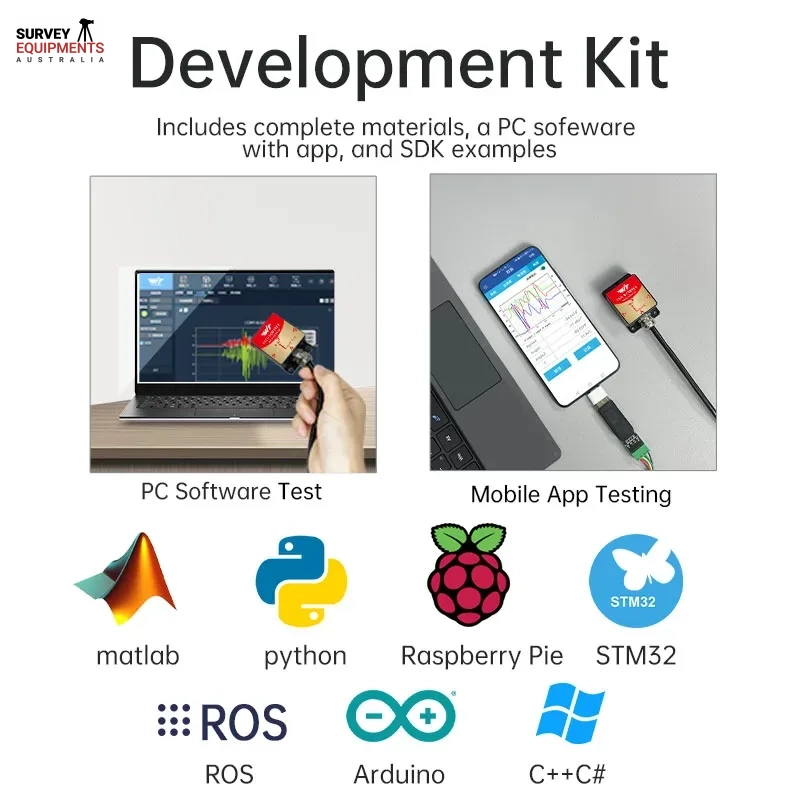
- Complete development kit : PC software, mobile app, sample code and protocol documentation for Windows, Linux, Android, Arduino, Raspberry Pi, STM32, ROS, Python, MATLAB and C/C++/C#.
Key Features of the HWT905 Tilt Sensor
High-Precision Factory Calibration
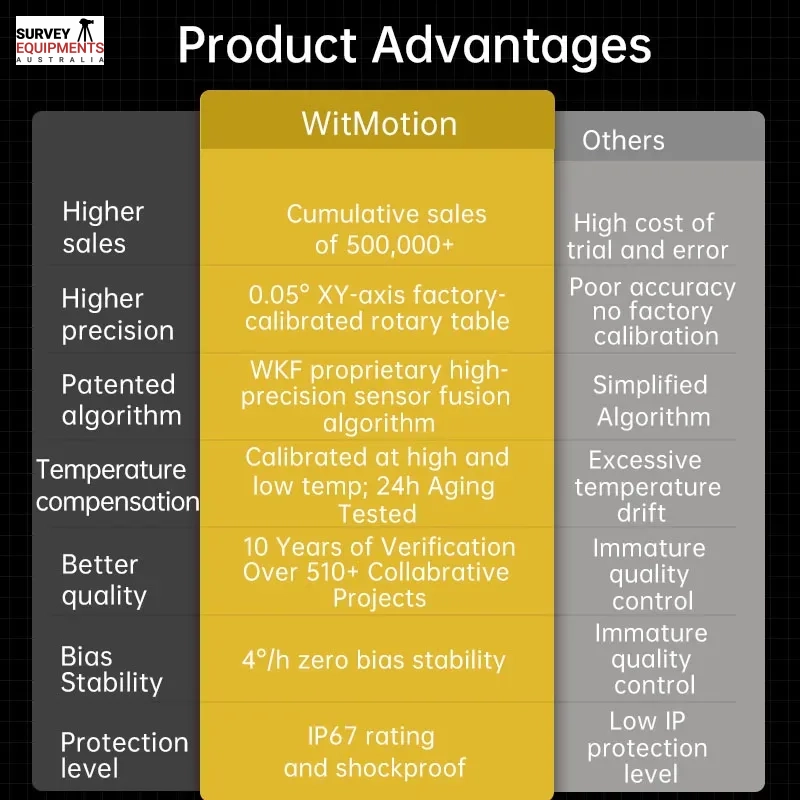
Every HWT905 is checked on a 0.01% three-axis non-magnetic rotary table and receives an inspection report. Calibrated X/Y error is held to 0.05°, compared with much larger errors on uncalibrated MEMS tilt modules.
Kalman-Filter Sensor Fusion
A built-in Kalman filter fuses accelerometer, gyroscope and magnetometer data to calculate orientation angles. The Z-axis maintains a stable heading under normal conditions, and the angle output resolution is 0.0055°/LSB.
32-Bit High-Speed Processor
A low-power 32-bit core running at up to 168 MHz processes sensor data quickly, supporting output rates from 0.2 Hz to 200 Hz (10 Hz default).
Temperature Compensation and Stability
The SCA3300 temperature-compensation chip and 24-hour high/low-temperature ageing tests minimise thermal drift, with 4°/h gyro zero-bias stability.
IP67 Waterproof, Shockproof Housing
The sealed housing resists splashes, rain and temporary submersion, making the sensor suitable for outdoor towers, pipelines, machinery and slope monitoring sites.
Easy Software Set-Up
The PC software shows live angle, acceleration, gyro and magnetic field data with 3D attitude display, magnetic field calibration (3D and biplane), data recording to file and configuration of baud rate, device address, bandwidth, install direction (horizontal/vertical) and algorithm (6-axis/9-axis).
HWT905 Inclinometer Specifications
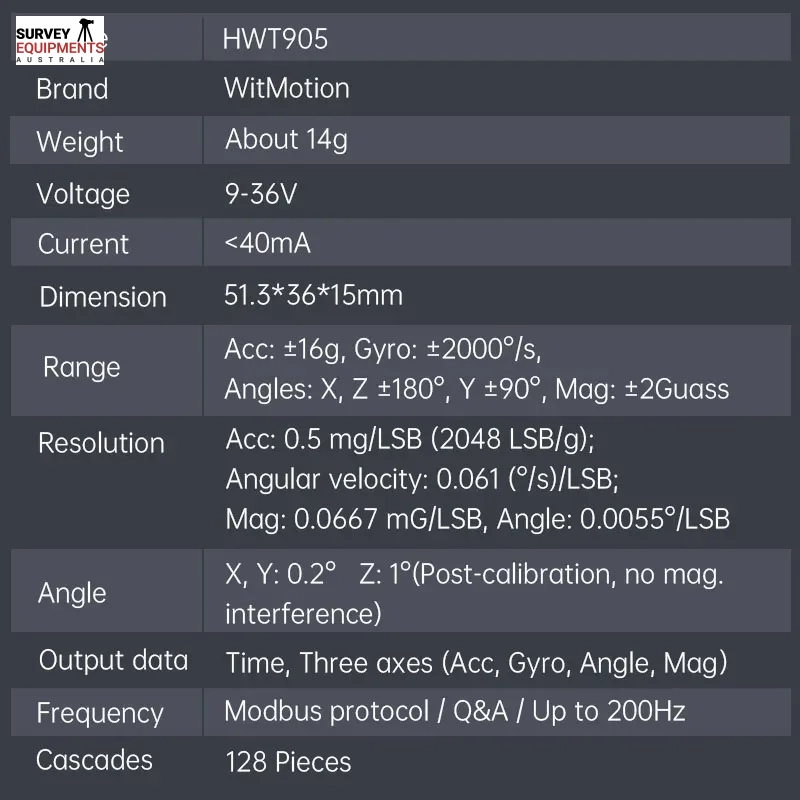
| Specification | Value |
|---|---|
| Brand | WitMotion |
| Model | HWT905 (HWT905-TTL / HWT905-RS232 / HWT905-RS485 / HWT905-CAN) |
| Sensor type | 9-axis attitude sensor / digital inclinometer (accelerometer + gyroscope + magnetometer) |
| Core sensors | RM3100 magnetometer, SCA3300 accelerometer / temperature compensation |
| Output data | 3-axis acceleration, angular velocity, angle, magnetic field, quaternion, temperature, time |
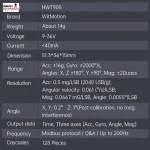
| Angle range | X (roll) and Z (yaw) ±180°; Y (pitch) ±90° |
| Angle accuracy | X/Y 0.05°; Z 1° (after calibration, no magnetic interference) |
| Acceleration range | ±6 g |
| Gyroscope range | ±2000°/s |
| Resolution | Acceleration 0.5 mg/LSB (2048 LSB/g); gyro 0.061 (°/s)/LSB; magnetic 13 nT/LSB; angle 0.0055°/LSB |
| Temperature drift | <0.002°/°C |
| Gyro bias stability | 4°/h |
| Accelerometer offset | ±20 mg |
| Gyro offset | ±0.5–1°/s |
| Interface | TTL, RS232, RS485 (Modbus) or CAN (select option) |
| Baud rate | Serial 2400–921600 bps (4800–230400 typical) |
| Output rate | 0.2–200 Hz (10 Hz default; RS485 question-and-answer mode) |
| Supply voltage | TTL / RS232 / RS485: 5–36 V DC; CAN: 5–24 V DC |
| Operating current | <40 mA |
| Boot time | 1000 ms |
| Processor | 32-bit, up to 168 MHz |
| Operating temperature | -40 °C to +85 °C |
| Shock resistance | 20,000 g |
| Ingress protection | IP67 |
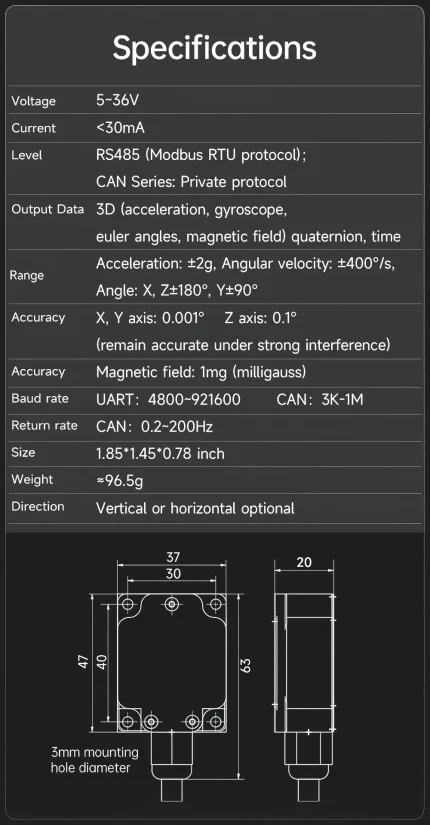
| Dimensions | 55 × 36.8 × 24 mm |
| Mounting | 2 × 3 mm mounting holes; horizontal or vertical installation |
| Cable | 1 m integrated cable |
| Software support | PC software, Android app, SDK and sample code |
| Condition | New |
Available Options
| Option | Description |
|---|---|
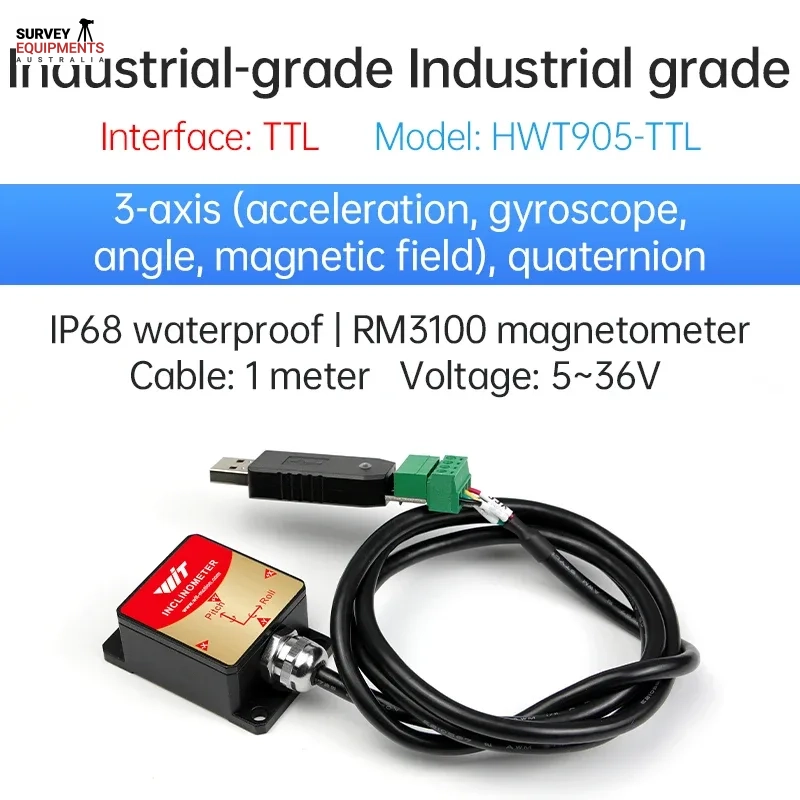
| HWT905-TTL | 9-axis inclinometer, TTL serial output, 1 m cable, USB serial converter |
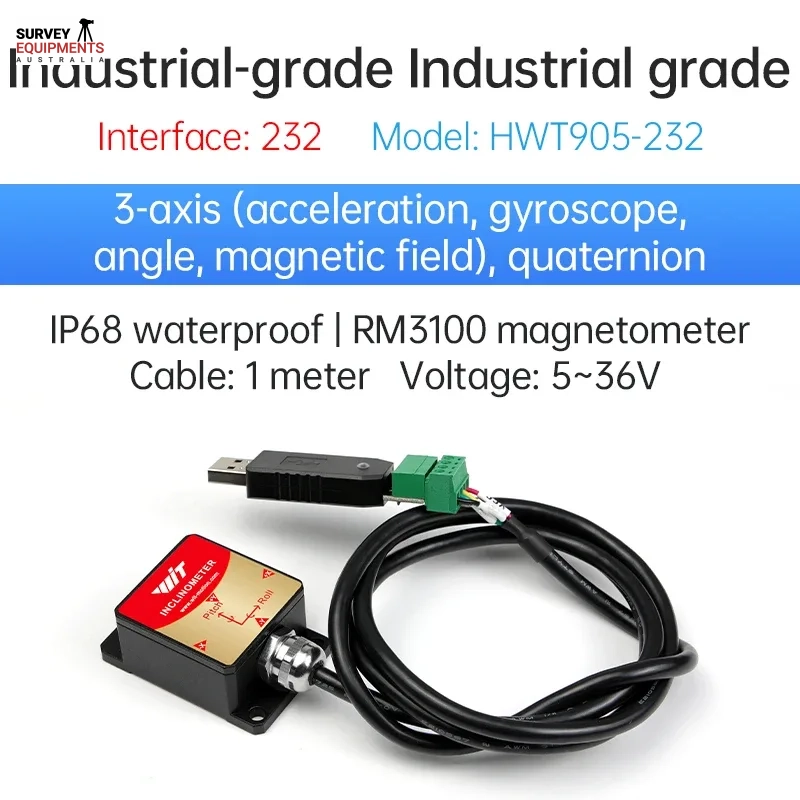
| HWT905-RS232 | 9-axis inclinometer, RS232 serial output, 1 m cable, USB serial converter |
| HWT905-RS485 | 9-axis inclinometer, RS485 Modbus output, 1 m cable, USB serial converter |
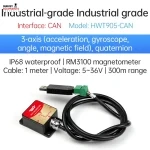
| HWT905-CAN | 9-axis inclinometer, CAN bus output, 1 m cable, USB converter |
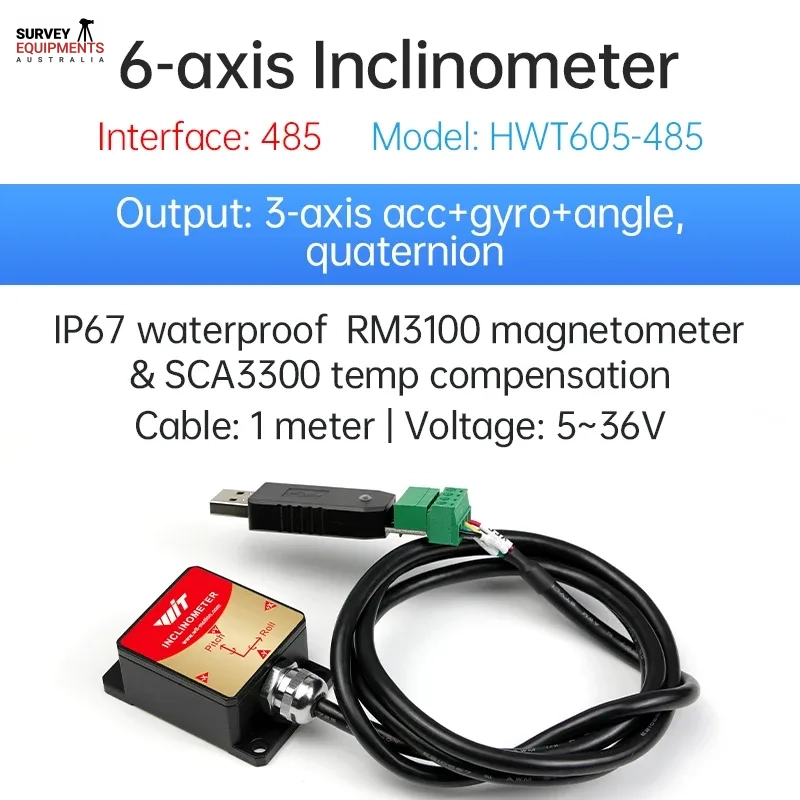
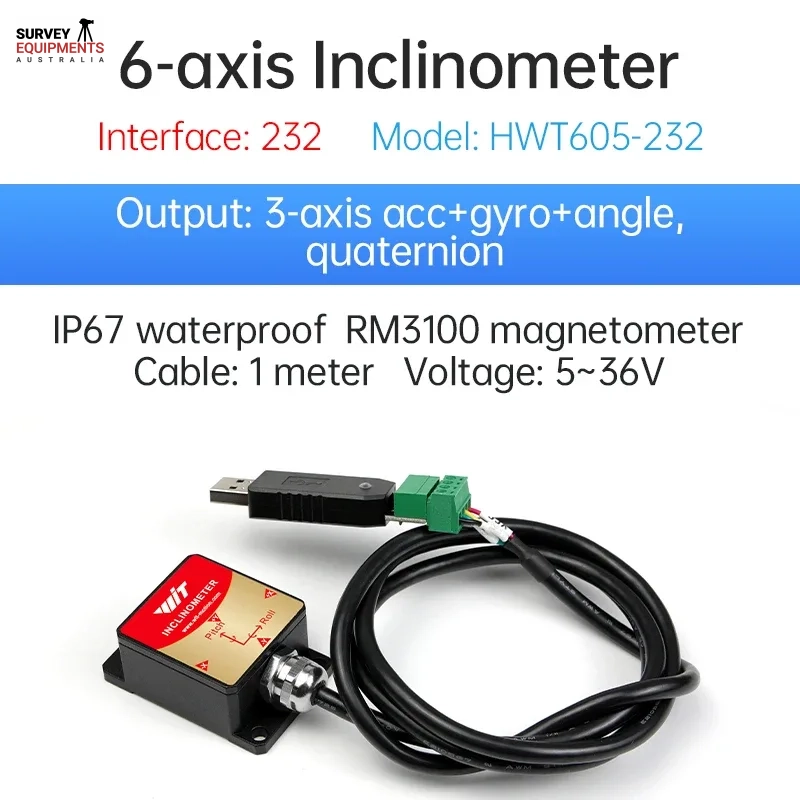
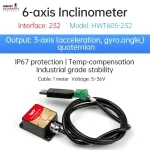
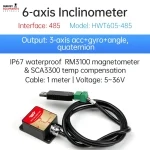
| HWT605-TTL | 6-axis inclinometer (acceleration, gyro, angle, quaternion – no magnetometer), X/Y 0.05°, Z 0.2°, TTL output |
| HWT605-RS232 | 6-axis inclinometer, X/Y 0.05°, Z 0.2°, RS232 output |
| HWT605-RS485 | 6-axis inclinometer, X/Y 0.05°, Z 0.2°, RS485 Modbus output |
| HWT605-CAN | 6-axis inclinometer, X/Y 0.05°, Z 0.2°, CAN bus output |
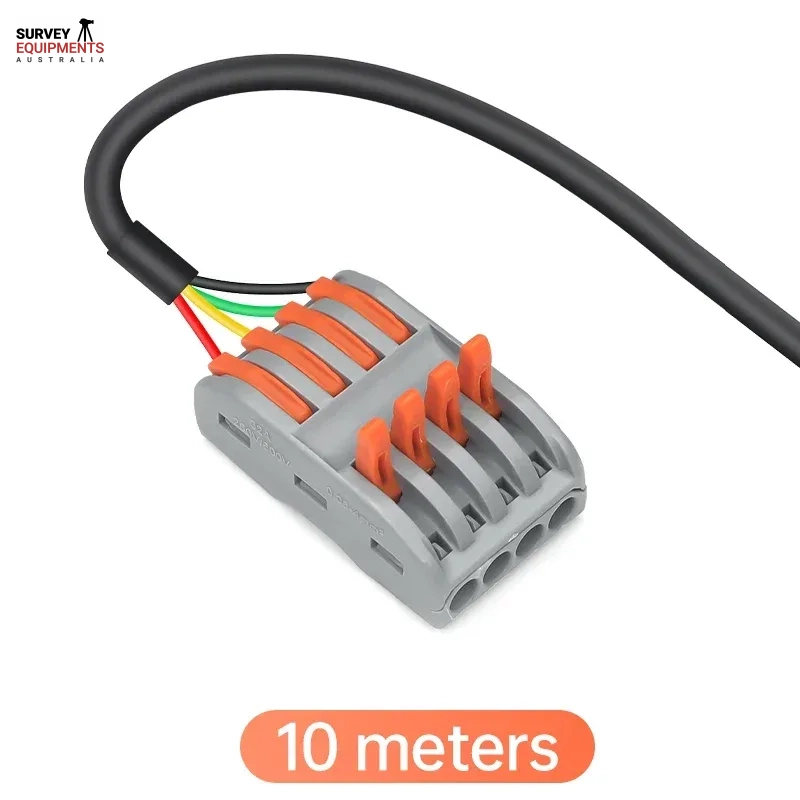
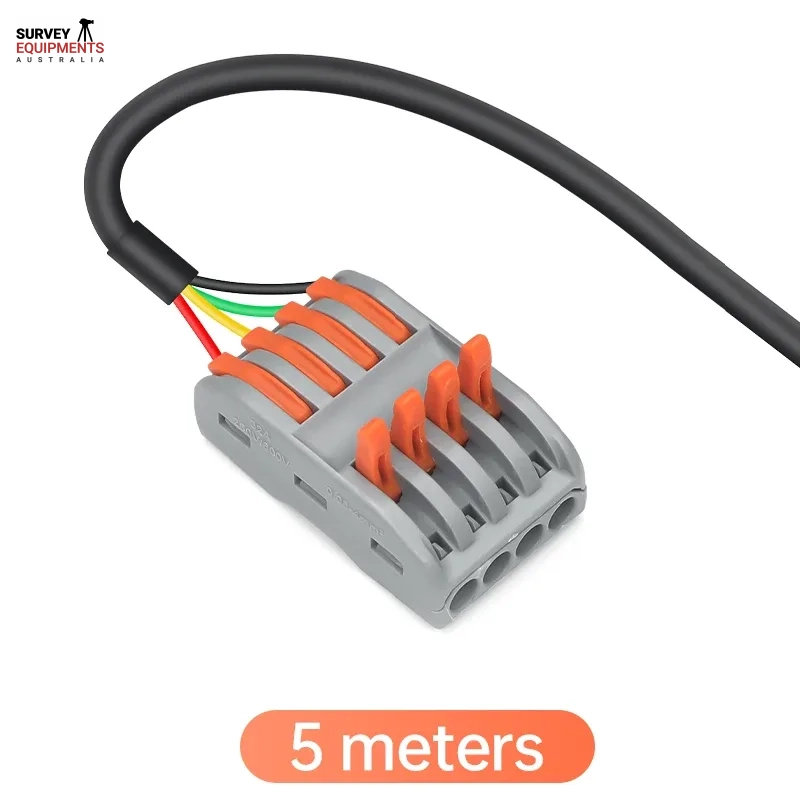
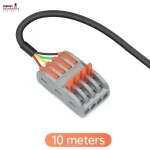
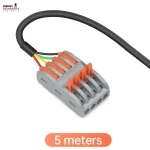
| Extension Cable 5 m | 5-metre 4-core extension cable with lever-type push terminal connector |
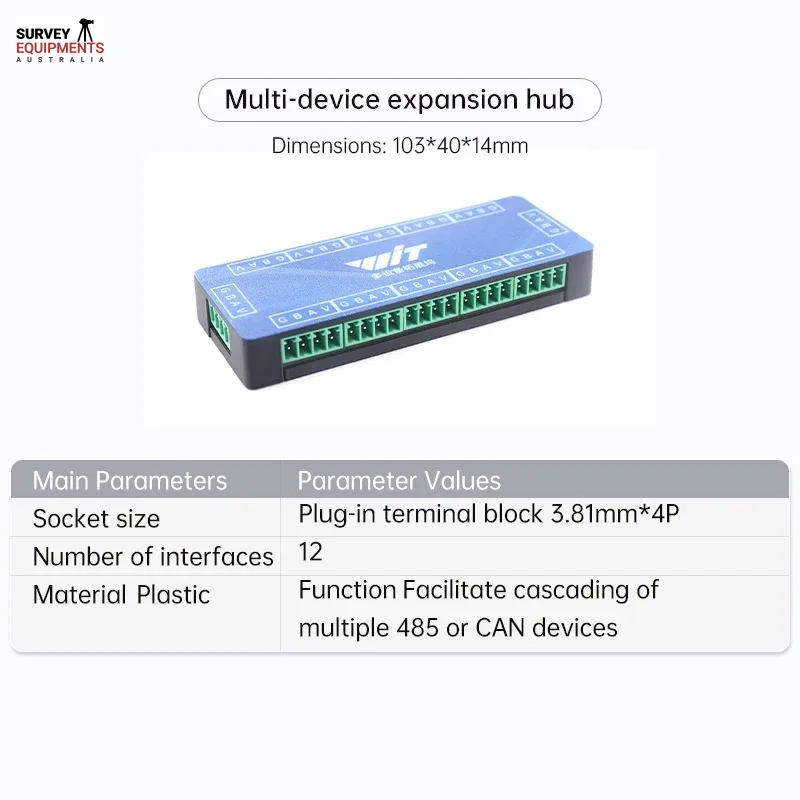
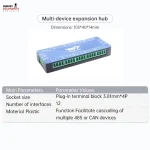
| Multi-Device Hub | 12-port expansion hub (103 × 40 × 14 mm, 3.81 mm 4-pin plug-in terminal blocks) for cascading multiple RS485 or CAN sensors |
What’s in the Box
Sensor options (HWT905 / HWT605):
- 1 × Inclinometer sensor with 1 m integrated cable (selected model and interface)
- 1 × USB serial converter module with green plug-in terminal block
- 1 × Packaging box
Accessory options: 1 × 5 m extension cable, or 1 × multi-device hub, as selected.
Condition: New
Applications for the HWT905 Industrial Tilt Sensor
- Construction machinery : Tilt and attitude monitoring of cranes, excavators, lifts and tower cranes to help prevent overturning.
- Automation equipment : Level and attitude calibration for AGVs, production lines and industrial robots.
- Geotechnical and structural monitoring : Slope displacement, landslides, bridge deflection, building health, suspension bridges and HV power and communication towers.
- Pipelines and utilities : Oil pipeline monitoring and tilt alarms on outdoor infrastructure.
- Marine and vehicle navigation : Ship attitude, vehicle slope measurement and unmanned vehicle path planning.
- Solar and positioning systems : Photovoltaic tracker brackets, PTZ heads and equipment levelling.
- Research and education : Robotics, control engineering teaching and attitude algorithm verification.
HWT905 vs HWT605: Which Should You Choose?
Choose the HWT905 when you need a magnetometer-based heading (yaw) reference alongside 0.05° pitch and roll. Choose the HWT605 when you only need precise pitch and roll and want a lower-cost 6-axis sensor; its Z-axis angle is gyro-derived (0.2°) rather than referenced to magnetic north.
Related Survey and Sensing Equipment
- WitMotion HWT9073 AHRS IMU Sensor 0.001° Accuracy
- Digital Track Level Gauge for Cant & Superelevation Measurement
- LVDT8 Displacement Sensor
- DQL-8 Geological Compass Pocket Transit
- UM982 Dual Antenna RTK GNSS Heading Receiver
Frequently Asked Questions
What does the WitMotion HWT905 inclinometer measure?
It measures 3-axis acceleration, angular velocity, angle (roll, pitch and yaw), magnetic field and quaternion, plus internal temperature, and outputs the data digitally at up to 200 Hz.
How accurate is the HWT905 tilt sensor?
The HWT905 delivers 0.05° accuracy on the X and Y axes and 1° on the Z axis after calibration, in an environment without magnetic interference. Each unit is calibrated on a 0.01% non-magnetic rotary table.
Which interface should I choose TTL, RS232, RS485 or CAN?
Use TTL for microcontrollers and short runs, RS232 for PC serial ports, RS485 (Modbus) for long cable runs and multi-sensor PLC networks, and CAN for vehicle and machinery buses. RS485 and CAN support up to 128 sensors on one line.
What power supply does the HWT905 need?
TTL, RS232 and RS485 versions run on 5–36 V DC, and the CAN version runs on 5–24 V DC. Current draw is under 40 mA.
Is the HWT905 waterproof?
Yes. The housing is rated IP67 for dust and water protection and is shock rated to 20,000 g, so it can be installed outdoors on machinery, towers and slopes.
What software is included with the HWT905?
A PC configuration and data-logging program, an Android app, SDK examples and protocol documentation are available, with examples for Arduino, Raspberry Pi, STM32, ROS, Python, MATLAB and C/C++/C#.
What is the difference between the HWT905 and HWT605?
The HWT905 is a 9-axis sensor with an RM3100 magnetometer for absolute heading. The HWT605 is a 6-axis sensor (accelerometer and gyroscope) with the same 0.05° X/Y accuracy but a gyro-based Z-axis of 0.2°.

Reviews
There are no reviews yet.