




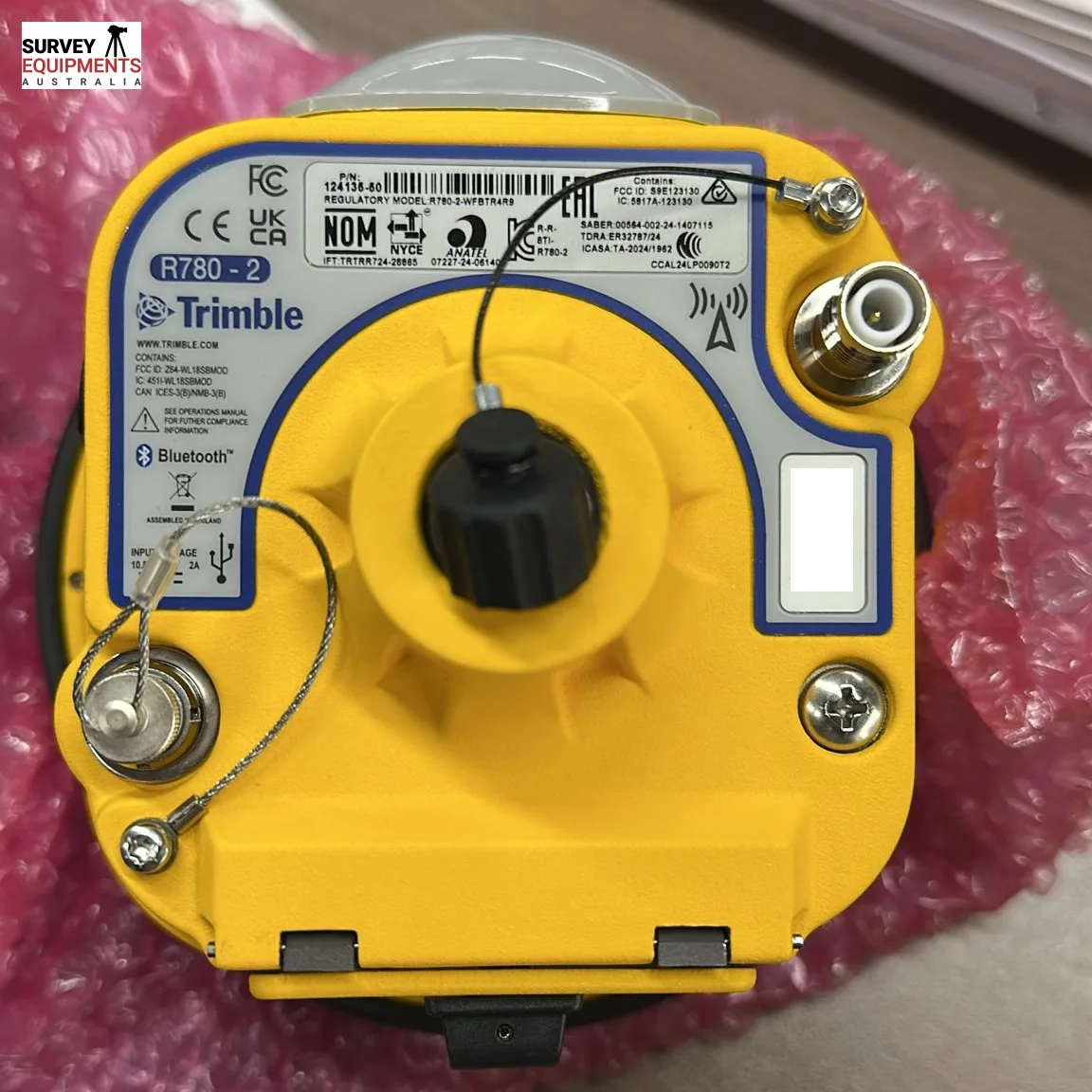



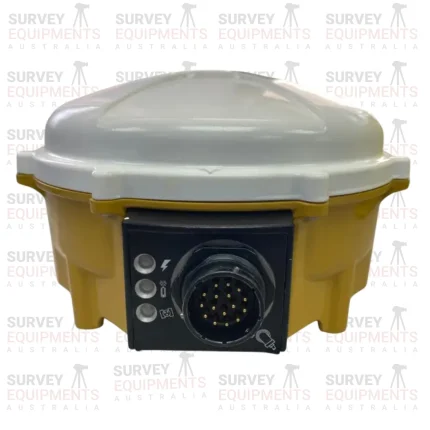
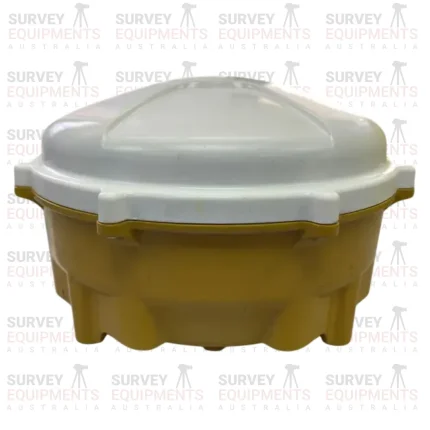
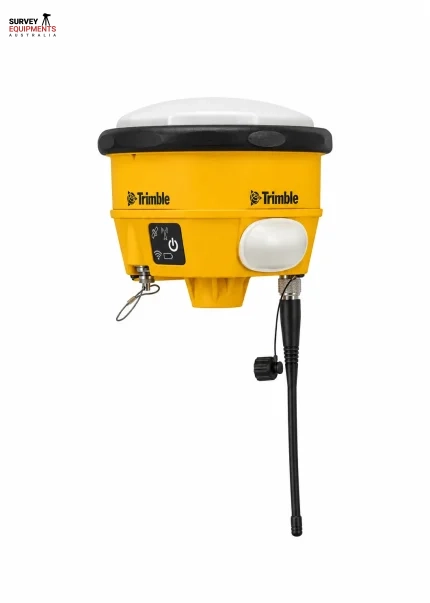
The Trimble R780-2 (R780 Model 2) is an integrated GNSS smart antenna receiver for RTK surveying, construction layout and site control, combining a 672-channel GNSS engine, IMU tilt compensation and an internal dual-band 450/900 MHz UHF radio in one rugged housing. This refurbished unit is a full option configuration with GPS, GLONASS, Galileo and BeiDou installed, base transmit and rover functions both enabled, and a clean serial number, giving survey and construction crews a current-generation Trimble receiver well below new-unit cost.
Trimble R780-2 Overview: Full-Option Dual-Band RTK Receiver
The R780-2 is built around dual Trimble Maxwell 7 GNSS chips with 672 channels and the Trimble ProPoint positioning engine. It tracks every current civil signal from GPS, GLONASS, Galileo, BeiDou, QZSS, NavIC and SBAS, and adds Trimble RTX corrections over L-band. EVEREST Plus multipath rejection, IonoGuard ionospheric protection, a built-in spectrum analyser and anti-spoofing capability keep positions reliable under tree canopy, near structures and in areas with radio interference.
The Trimble Inertial Platform (TIP) lets you measure and stake points with the pole tilted up to 30°, so you can work in corners, against walls and around obstacles without levelling the bubble on every shot. With 9 GB of internal storage, Wi-Fi, Bluetooth and an IP68 housing rated for a 2 m pole drop, the R780-2 is ready for daily field use on construction sites and survey projects.
This unit is supplied in very good used condition with a clean serial number and has been checked for correct operation in base and rover modes.
Key Benefits of the Refurbished Trimble R780-2
- Full option licence: GPS, GLONASS, Galileo (incl. E6), BeiDou (incl. B1C and B3), QZSS, NavIC, L2C, L5 and L1C tracking all installed.
- Dual-band internal radio: 450 MHz (410–473 MHz) and 900 MHz (902–928 MHz) transceiver with transmit enabled, so one receiver can run as a radio base or a rover on either band.
- Base and rover in one unit: broadcast RTK corrections from a known point, or receive corrections over radio, VRS or internet.
- TIP tilt compensation: IMU-based tilt measurement and stakeout up to 30° pole tilt, immune to magnetic interference.
- Fast, robust fixes: RTK start-up in typically 2–8 seconds, with xFill bridging short correction outages.
- Built for the field: IP68 protection, -40 °C to +65 °C operating range, 100% humidity rating and 2 m pole-drop survival.
- Strong value: full-option R780-2 capability for significantly less than a new receiver.
Trimble R780-2 Features
GNSS Tracking and Positioning Technology
- Dual Trimble Maxwell 7 GNSS chipset with 672 channels
- Trimble ProPoint GNSS engine for better performance in obstructed sky
- EVEREST Plus multipath rejection and IonoGuard ionospheric mitigation
- Built-in spectrum analyser and anti-spoofing capability
- Trimble xFill and CenterPoint RTX over satellite or internet (subscription required)
- Position rates of 1, 2, 5, 10 and 20 Hz (20 Hz installed on this unit)
Tilt Compensation (Trimble Inertial Platform)
- IMU-based tilt compensation for measurement and stakeout up to 30°
- Horizontal RTK tilt accuracy of 8 mm + 0.5 mm per degree of tilt
- IMU integrity monitoring for temperature, age and shock bias
Radio, Corrections and Connectivity
- Fully sealed internal 450 MHz and 900 MHz UHF transceiver, receive and transmit
- CMR, CMR+, CMRx and RTCM 2.1–3.2 input and output; VRS rover support; unlimited RTK baseline length
- Trimble IBSS internet base station streaming support (Trimble Access 2023.10 or later)
- Wi-Fi b/g/n (client or access point) and sealed 2.4 GHz Bluetooth
- 7-pin Lemo port for serial, USB and external power
- NMEA (24 messages), GSOF, RT17 and RT27 outputs; 9 GB internal data logging
Installed Options on This Trimble R780-2 (450/900 MHz Full Option)
| Option | Status | Option | Status |
|---|---|---|---|
| GPS | Installed | GLONASS | Installed |
| Galileo | Installed | Galileo E6 | Installed |
| BeiDou | Installed | BeiDou B1C / B3 | Installed |
| QZSS / QZSS L1C / QZSS LEX | Installed | NavIC | Installed |
| L1C Tracking | Installed | L2C | Installed |
| Dual Frequency Tracking (L2) | Installed | Triple Frequency Tracking (L5) | Installed |
| EVEREST | Installed | Maximum Measurement Rate | 20 Hz |
| VRS | Installed | Dual Frequency MSS | Installed |
| CMR Input / CMR Output | Installed | CMRx Input / CMRx Output | Installed |
| RTCM Input / RTCM Output | Installed | RTCM DGNSS Input | Installed |
| RTK Support | Installed | RTK Baseline Length Limit | No Limit |
| Transmit (Base) | Installed | NMEA / Binary Outputs | Installed |
| Data Logging / USB Hard Drive | Installed | Bluetooth / Wi-Fi | Installed |
| Sensors / Inertial Navigation | Installed | Spectrum Analyser | Installed |
| HTTPS / Enhanced Security | Installed | – | – |
Options not installed on this unit: Transmit High Power (1 W), Moving Base, Heading Mode Only, Advanced RTCM Output, RTCM DGNSS Output, Programmatic Interface, Position Monitoring, RTX Integrity Monitoring and ALO.
Trimble R780-2 Technical Specifications
| Brand / Model | Trimble R780-2 (R780 Model 2) GNSS Receiver |
|---|---|
| Configuration | Full option, base and rover, internal 450/900 MHz dual-band radio |
| Condition | Refurbished (used, very good condition, clean serial number) |
| GNSS Chipset / Channels | Dual Trimble Maxwell 7, 672 channels |
| GPS | L1C, L1 C/A, L2E (L2P), L2C, L5 |
| GLONASS | L1 C/A, L1P, L2 C/A, L2P, L3 |
| Galileo | E1, E5A, E5B, E5 AltBOC, E6 |
| BeiDou | B1, B2, B3, B1C, B2A, B2B |
| QZSS / NavIC / SBAS | QZSS L1 C/A, L1C, L1S, L2C, L5, LEX/L6; NavIC L5; SBAS L1 C/A, L5 |
| L-band | Trimble RTX (subscription required) |
| RTK Accuracy (single baseline <30 km) | Horizontal 8 mm + 1 ppm RMS; Vertical 15 mm + 1 ppm RMS |
| Network RTK Accuracy | Horizontal 8 mm + 0.5 ppm RMS; Vertical 15 mm + 0.5 ppm RMS |
| Static / Fast Static | Horizontal 3 mm + 0.5 ppm RMS; Vertical 5 mm + 0.5 ppm RMS |
| High-Precision Static | Horizontal 3 mm + 0.1 ppm RMS; Vertical 3.5 mm + 0.4 ppm RMS |
| Tilt-Compensated RTK (TIP) | Horizontal 8 mm + 0.5 mm/° tilt, up to 30° |
| CenterPoint RTX | Horizontal 2 cm RMS; Vertical 3 cm RMS |
| Code Differential | Horizontal 0.25 m + 1 ppm RMS; Vertical 0.50 m + 1 ppm RMS |
| RTK Start-up Time | Typically 2–8 seconds |
| Internal UHF Radio | 450 MHz band 410–473 MHz (12.5 / 25 kHz spacing) and 900 MHz band 902–928 MHz (region dependent) |
| Radio Transmit Power | 0.5 W (1 W high-power option not installed) |
| Typical Radio Range | 3–5 km typical, up to 10 km in optimal conditions |
| Wireless | Wi-Fi b/g/n (client or access point), Bluetooth 2.4 GHz |
| Ports | 7-pin Lemo (serial, USB, external power), radio antenna connector |
| Correction Formats | CMR+, CMRx, RTCM 2.1, 2.3, 3.0, 3.1, 3.2 (input and output) |
| Data Outputs | 24 NMEA messages, GSOF, RT17, RT27 |
| Position Rate | 1, 2, 5, 10, 20 Hz |
| Internal Memory | 9 GB |
| Power Consumption | 3.2 W rover (radio receive); 5.2 W base (0.5 W radio transmit) |
| Internal Battery | Removable rechargeable Li-ion with UPS function |
| Battery Run Time (typical) | Approx. 5.5 h rover; approx. 4 h with 450 MHz or 900 MHz radio in use |
| External Power | 10.8–28 V DC via 7-pin Lemo, over-voltage protected |
| Dimensions | 13.9 cm × 13 cm (5.5 in × 5.1 in) including connectors |
| Weight | 1.55 kg (3.42 lb) including radio and battery |
| Operating Temperature | -40 °C to +65 °C (-40 °F to +149 °F) |
| Storage Temperature | -40 °C to +75 °C (-40 °F to +167 °F) |
| Humidity | 100%, condensing |
| Ingress Protection | IP68 (submersible to 1 m for 1 hour) |
| Drop / Shock | Survives 2 m (6.6 ft) pole drop onto concrete; 75 G non-operating, 40 G operating shock |
| Field Software | Optimised for Trimble Access |
Accuracy, range and run-time figures are manufacturer specifications and depend on satellite geometry, multipath, atmospheric conditions, baseline length, temperature and configuration.
Applications and Use Cases
- Construction layout and stakeout: fast tilt-compensated set-out of pegs, grades and structures.
- Site base station: broadcast 450 MHz or 900 MHz corrections to rovers and machine control systems.
- Topographic and engineering surveys: high-rate RTK collection with dependable fixes near buildings and vegetation.
- Cadastral and control surveys: static and fast-static logging to 9 GB internal memory.
- Mining, quarrying and earthworks: pit, stockpile and haul road surveys with a rugged IP68 receiver.
- Utility and infrastructure mapping: tilted pole shots at kerbs, walls and service pits.
What You Need to Run the R780-2
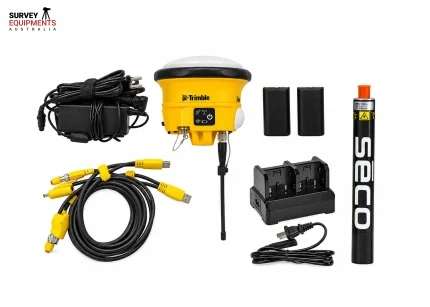
The R780-2 is an integrated smart antenna, so no separate GNSS antenna is needed. To work in the field you will also need a data collector running Trimble Access, a survey pole, a UHF radio whip antenna for the chosen band, and a charged battery or external 12 V supply for long base sessions.
Trimble R780-2 GNSS Receiver FAQs
What is the Trimble R780-2 used for?
The Trimble R780-2 is an integrated GNSS receiver used for RTK surveying, construction layout, site base stations and control work, operating as either a rover on a pole or a base broadcasting corrections.
Is this Trimble R780-2 a full option unit?
Yes. GPS, GLONASS, Galileo (incl. E6), BeiDou (incl. B1C and B3), QZSS, NavIC, L2C, L5, 20 Hz, VRS, CMR/CMRx/RTCM input and output, base transmit, rover and inertial tilt functions are all installed.
Which radio bands does this R780-2 support?
It has the internal dual-band radio covering 410–473 MHz and 902–928 MHz with transmit and receive enabled, at 0.5 W transmit power, giving a typical range of 3–5 km.
Does the Trimble R780-2 have tilt compensation?
Yes. The Trimble Inertial Platform (TIP) IMU allows measurement and stakeout with the pole tilted up to 30°, with horizontal accuracy of 8 mm + 0.5 mm per degree of tilt.
How accurate is the Trimble R780-2 in RTK mode?
Manufacturer RTK accuracy is 8 mm + 1 ppm horizontal and 15 mm + 1 ppm vertical (RMS), with typical start-up in 2–8 seconds.
Does the Trimble R780-2 need a separate GNSS antenna?
No. The R780-2 is an integrated GNSS smart antenna with the antenna, receiver, radio and battery in one housing. Only a UHF whip antenna for the selected radio band is fitted to the radio connector.
What condition is this refurbished R780-2 in?
It is a used unit in very good cosmetic and working condition with a clean serial number, checked for correct operation before dispatch.
How long does the battery last?
Typically around 5.5 hours as a rover and about 4 hours with the internal 450 MHz or 900 MHz radio in use. An external 10.8–28 V DC supply can be connected for long base sessions.





Reviews
There are no reviews yet.