



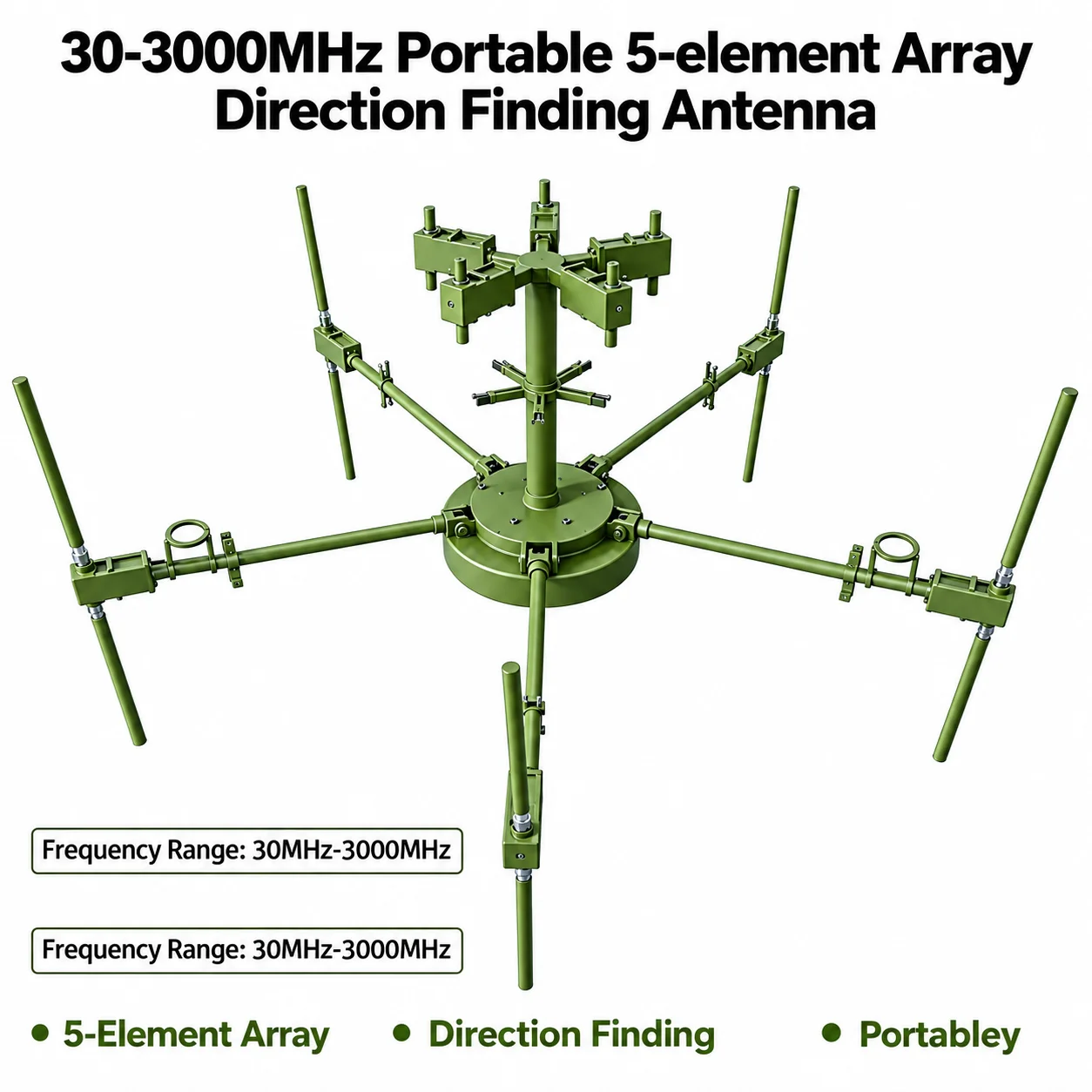
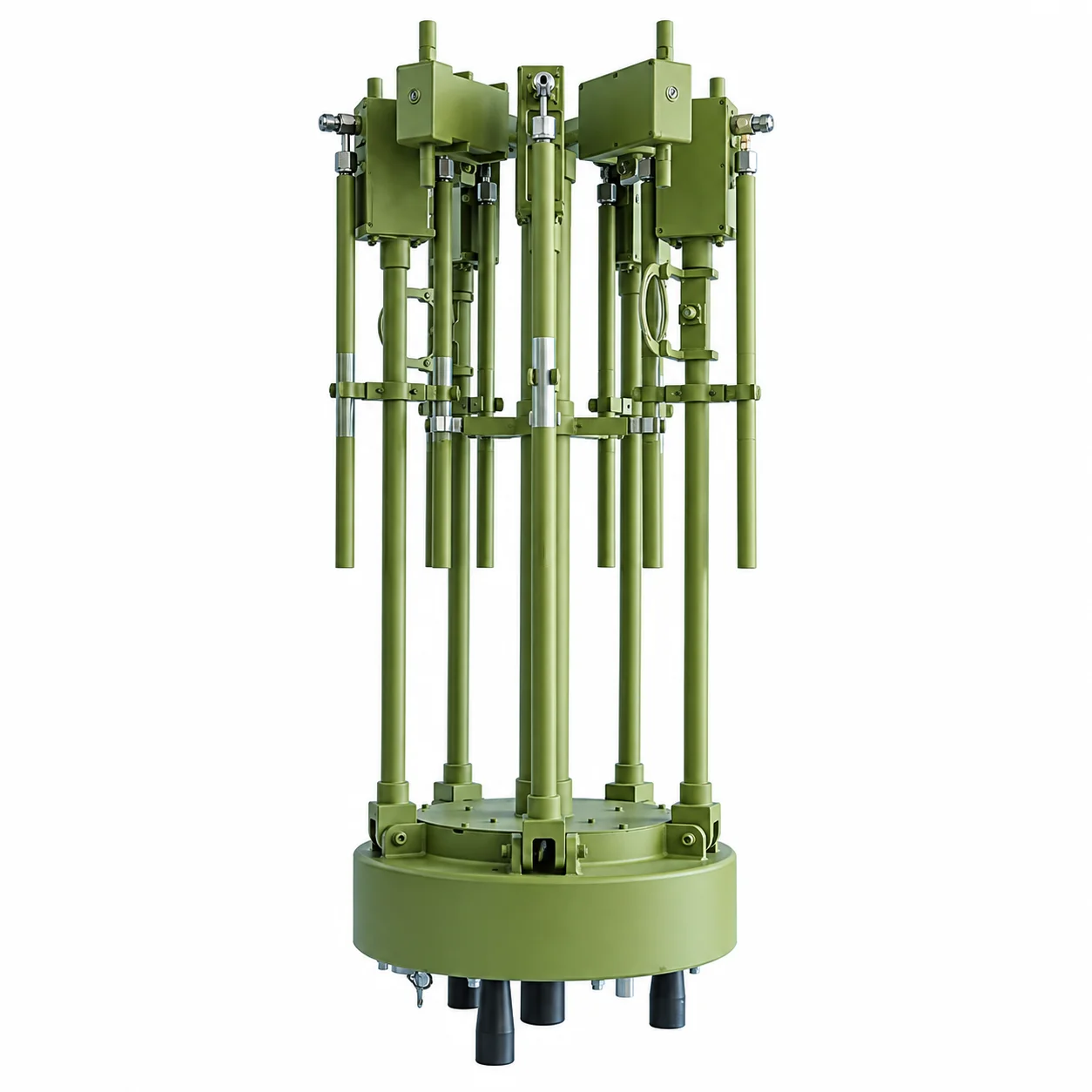
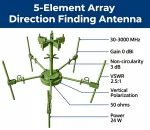
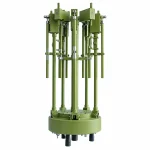


A direction finding antenna is a multi-element RF array used to determine the bearing of a radio signal source. This portable 5-element direction finding antenna covers a wide 30–3000MHz frequency range, giving security, defence and RF field teams a single wideband array for drone detection, signal reconnaissance and spectrum monitoring in one compact, field-deployable unit.
Why Choose This Direction Finding Antenna
- Wideband coverage: A single array spans 30–3000MHz, replacing the need for multiple narrowband antennas.
- Built for drone detection: Designed to help locate the bearing of RF signals associated with UAV control and video links.
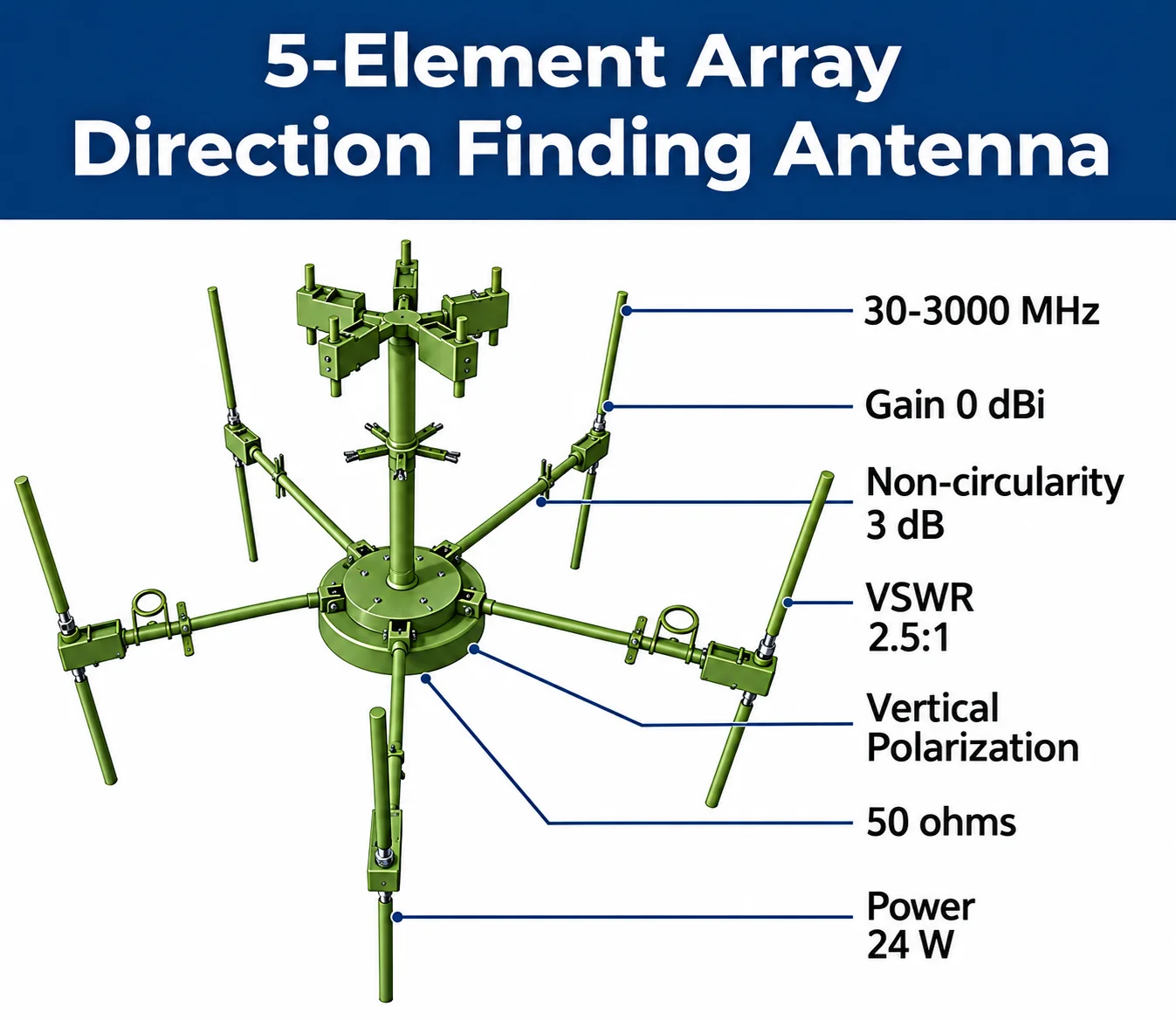
- Accurate bearing performance: Low antenna non-circularity (≤3dB) and VSWR (≤2.5:1) support consistent direction finding results.
- Portable design: Lightweight aluminium construction suited to field deployment, temporary installations and mobile security operations.
- Field-rugged: Rated for use at altitudes of at least 5000m for demanding outdoor and remote-site conditions.
Key Features
Wideband 30–3000MHz Coverage
The antenna’s frequency range spans VHF through to low-microwave frequencies, covering common two-way radio, telemetry and drone control-link bands within a single array.
5-Element Direction Finding Array
Five vertically polarised elements are arranged around a central mast to support amplitude/phase-based bearing detection when paired with a compatible RF direction finding receiver.
Low Non-Circularity for Accurate Bearing
A design-guaranteed antenna non-circularity of ≤3dB helps keep bearing error low and consistent across the full frequency range.
Low-Power, Field-Ready Electronics
Onboard feed electronics draw ≤24W from an external DC supply, keeping the antenna practical for portable, vehicle-mounted or solar/battery-backed installations.
Durable Aluminium Build
Aluminium construction keeps the array lightweight without sacrificing structural durability for repeated field deployment.
Technical Specifications
| Specification | Value |
|---|---|
| Model Number | ZB-DFA-30/3000 |
| Feature | Direction Finding Antenna |
| Application | Drone Detection / RF Direction Finding |
| Frequency Range | 30–3000MHz |
| Antenna Configuration | 5-element array |
| Antenna Gain | ≥0dBi (typical value) |
| Antenna Non-circularity | ≤3dB (typical value, design guaranteed) |
| VSWR | ≤2.5:1 |
| Polarisation | Vertical |
| Characteristic Impedance | 50Ω (nominal) |
| Low-band Element Length | 680mm |
| Burnout Resistance Power | 1W continuous wave (design guaranteed) |
| Power Consumption | ≤24W |
| Altitude Rating | Suitable for altitudes of at least 5000m |
| Material | Aluminium |
| Condition | New |
| Selling Unit | Single antenna array unit |
Applications & Use Cases
- Counter-drone / UAS detection and RF-based bearing tracking
- RF spectrum monitoring and signal reconnaissance
- Perimeter and boundary security surveillance
- Defence, law enforcement and critical infrastructure protection
- Search and rescue signal tracking
- Radio communications testing and EMC/EMI field work
How a Direction Finding Antenna Works
A direction finding (DF) antenna array uses multiple elements in this case five arranged around a central point to compare the relative amplitude and phase of an incoming RF signal at each element. That comparison, processed by a compatible DF receiver, is used to calculate the bearing (direction) of the transmitting source.
Wideband coverage from 30–3000MHz means one array can be used to search for and localise a broad range of signal types, from handheld two-way radios through to drone control and video downlink frequencies.
Note: this listing is for the antenna array itself. A compatible RF direction finding receiver/processor and mounting hardware are sold separately.
Frequently Asked Questions
What frequency range does this direction finding antenna cover?
This direction finding antenna covers a wide 30–3000MHz frequency range, making it suitable for VHF/UHF signal detection tasks including drone control-link and telemetry frequencies, two-way radio bands and general RF reconnaissance.
Is this antenna suitable for drone detection?
Yes. The antenna is designed for drone detection applications, using its 5-element array to help identify the direction of RF signals commonly associated with UAV control and video links.
What is the antenna gain and VSWR of this direction finding antenna?
The antenna has a typical gain of ≥0dBi and a VSWR of ≤2.5:1, with a design-guaranteed non-circularity of ≤3dB, which supports consistent, low-error bearing accuracy across its full frequency range.
Does this direction finding antenna need external power?
Yes. The antenna’s onboard feed electronics draw up to 24W from an external DC power supply, which keeps power consumption low for portable and semi-permanent installations.
What polarisation does this antenna use?
This antenna uses vertical polarisation, the standard configuration for most VHF/UHF ground-based and portable RF direction finding and drone detection setups.
Can this antenna be used at altitude or in harsh outdoor conditions?
Yes. It’s rated for use at altitudes of at least 5000m and is built from aluminium for durability in outdoor and field deployments.
Is a receiver or DF processor included?
No. This listing is for the direction finding antenna array only. A compatible RF direction finding receiver/processor and any mounting hardware are sold separately contact us to confirm compatibility with your existing DF system.
Related Products
- VHF Marine Antenna (156–163MHz) a complementary VHF antenna for marine and two-way radio applications.
- Automotive Broadband Coaxial Antenna (144/430MHz) a magnetic-mount antenna covering overlapping VHF/UHF bands.
- AN/PRC-152/148 6-Pin Radio Adapter a connector accessory for tactical and two-way radio systems.
- Underground Pipeline & Cable Detector another precision RF-based direction/locating instrument.
- Radiodetection RD8200 Protective Carry Bag a field carry case suited to portable RF detection equipment.


Reviews
There are no reviews yet.