



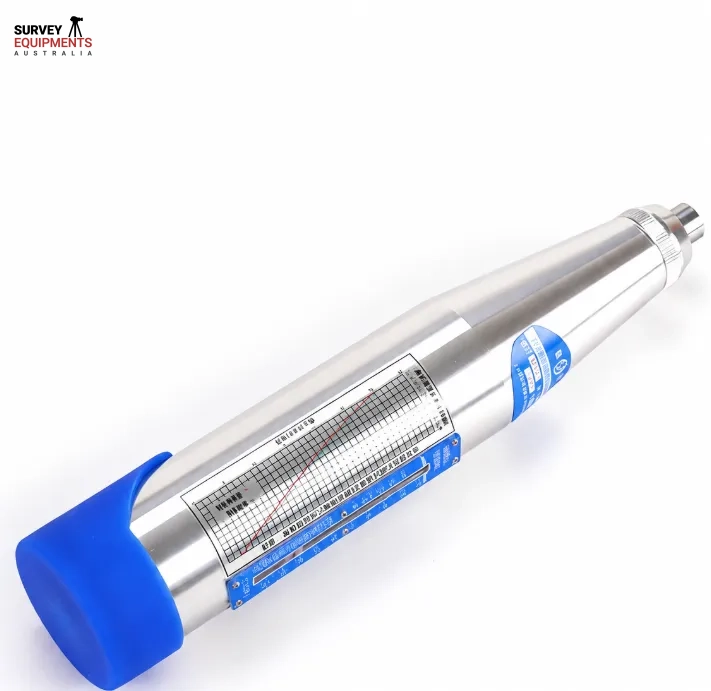


The Digital Concrete Test Hammer is a handheld Schmidt-type rebound tester for non-destructive assessment of hardened concrete. It applies a 2.207 J impact and measures surface rebound to estimate compressive strength over a stated range of 10–60 MPa. The English-language LCD, audible announcements and USB export help inspectors collect and organise readings on site.
Features and benefits
- English LCD and audible announcements : Review readings on screen and use voice prompts during repeated measurements.
- Automatic measurement recording : Capture and store rebound values, and view the instrument’s calculated strength estimate while testing.
- USB data export : Transfer recorded measurements for project records and inspection reports.
- On-screen data review : Review readings by test area, with summary values including average strength, minimum strength and standard deviation shown in the instrument interface.
- Portable field setup : The 1.0 kg instrument is supplied with a storage case and accessory set.
Technical specifications
| Specification | Value |
|---|---|
| Instrument type | Digital concrete rebound hammer (Schmidt-type) |
| Stated compressive strength estimation range | 10–60 MPa |
| Nominal impact energy | 2.207 J |
| Impact stroke | 75 mm |
| Reference anvil rebound value | 80 ± 2 |
| Pointer-to-display difference | Up to 0.5 rebound units |
| Rated sensor life | More than 200,000 cycles |
| Protection rating | IP30 |
| Display and menu | Digital LCD with English-language menu |
| Data functions | Automatic capture, conversion and storage. USB data export for reporting. |
| Audible feedback | Voice announcements |
| Instrument dimensions | 275 × 55 × 85 mm |
| Net instrument weight | 1.0 kg |
Concrete testing applications
Construction quality checks and condition surveys
Compare readings across concrete slabs, walls, columns and beams to identify areas requiring a closer look during construction quality checks or inspections of existing buildings and bridges.
Field verification and interpretation
Check the hammer against an appropriate reference anvil and follow the project’s test method. Surface moisture, carbonation, texture and impact orientation can affect rebound numbers. Use a relationship established for the concrete under investigation when estimating in-place strength.
Related concrete testing equipment
- U200 ultrasonic concrete rebound hammer
- HT-225T and HT-225J digital rebound hammers
- ZC3-A mechanical concrete rebound hammer
Frequently Asked Questions
What does this digital concrete test hammer measure?
It measures the rebound number of hardened concrete. The instrument uses a conversion curve to display an estimated compressive strength.
What is its measuring range and impact energy?
The stated strength estimation range is 10–60 MPa and the nominal impact energy is 2.207 J.
Does it have an English menu and voice announcements?
Yes. The LCD menu is in English and the hammer provides audible voice announcements during testing.
Can I save and export readings?
Yes. The instrument records and stores readings and supports USB export for preparing inspection reports.
What is the reference value for an anvil check?
The stated reference anvil rebound value is 80 ± 2. Use an appropriate reference anvil and follow the project’s verification procedure.
How should I interpret the displayed strength estimate?
Use rebound readings to compare concrete uniformity across similar test areas. A reliable estimate of in-place strength requires a correlation for the concrete and instrument in use. Follow the applicable project procedure for acceptance decisions.


