





ATP1 Type 360-Degree Prism is a high-precision 360° surveying prism designed for use with total stations, robotic total stations, prism poles, and geospatial measurement equipment. Its multi-directional reflective design allows the prism to return measurement signals from virtually any horizontal direction, helping surveyors maintain reliable target acquisition without repeatedly rotating or repositioning the prism.
Built for demanding land surveying, construction surveying, engineering, positioning, and machine-control applications, this 360-degree prism for total stations can improve field productivity where continuous target tracking and flexible prism orientation are important.
ATP1 360-Degree Prism – Efficient Multi-Directional Surveying
Unlike a conventional single-direction survey prism that requires careful orientation toward the total station, the ATP1 Type 360-Degree Prism provides reflective coverage around the prism. This makes it particularly suitable for robotic total station surveying, where the instrument needs to automatically locate and track a moving target.
The prism features 5/8 x 11 female mounting threads on both sides, providing compatibility with standard surveying accessories and allowing flexible installation on a survey prism pole or other compatible mounting equipment.
Key Features and Benefits
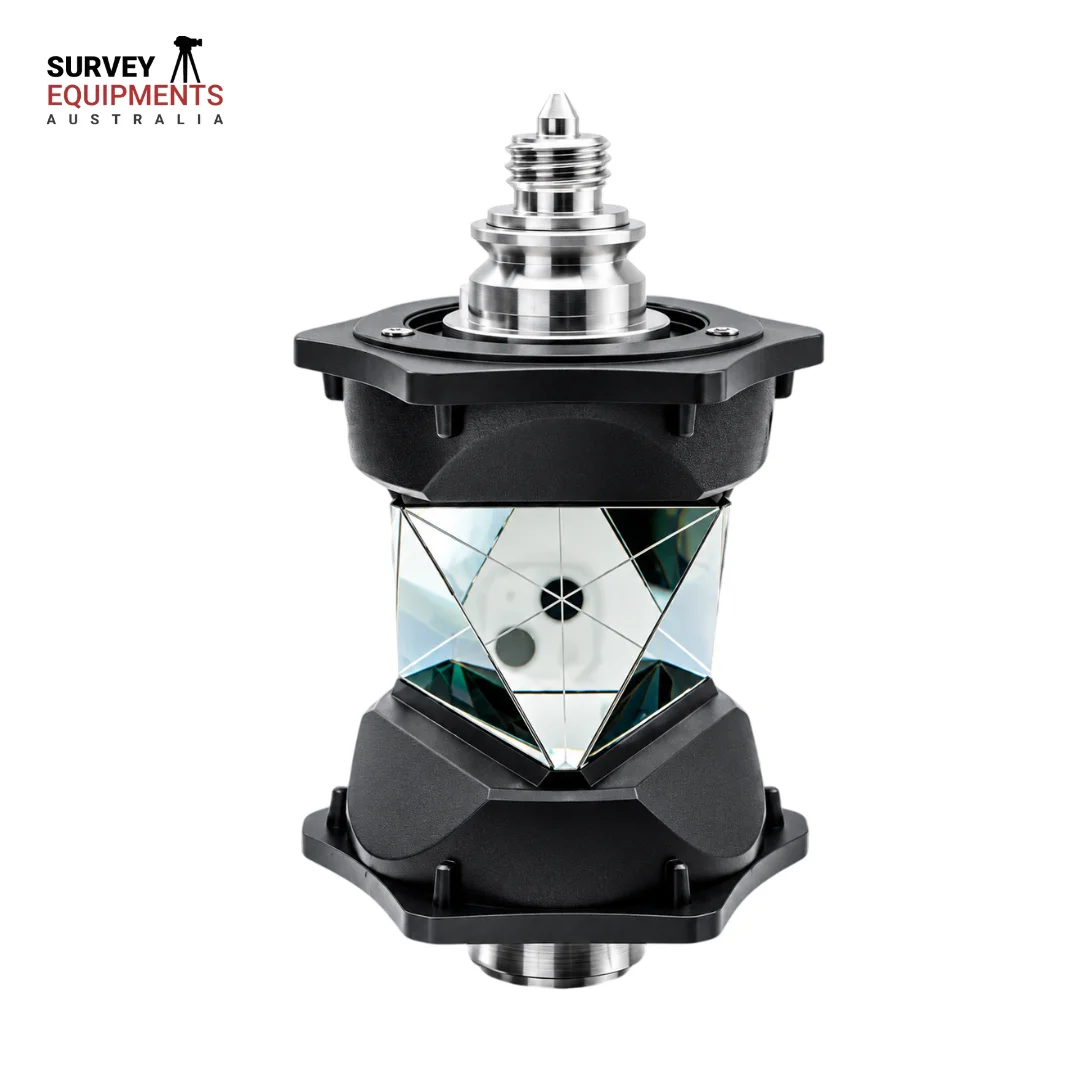
- 360-degree reflective coverage for multi-directional total station measurements
- Designed for total stations and robotic total stations
- Supports efficient automatic prism tracking applications
- 5/8 x 11 female threads on both sides for standard surveying compatibility
- Suitable for prism poles and surveying accessories
- Helps reduce the need to manually rotate the prism toward the instrument
- Useful for distance measurement, position tracking, and coordinate surveying
- Suitable for land surveying, construction, civil engineering, and geospatial applications
- Precision optical prism construction for dependable surveying measurements
- Designed for field environments where consistent target visibility and positioning are important
ATP1 Type 360-Degree Prism Specifications
| Product Specification | Details |
|---|---|
| Product Name | ATP1 Type 360-Degree Prism |
| Product Type | 360° Surveying Prism |
| Primary Use | Total station surveying and target positioning |
| Reflective Coverage | 360 degrees |
| Compatible Instruments | Total stations, robotic total stations |
| Mounting Thread | 5/8 x 11 female thread |
| Thread Configuration | Female threads on both sides |
| Prism Constant | -7 mm (ATP1 type) |
| Weight | Approx. 0.2 kg |
| Mounting Compatibility | Compatible prism poles and standard surveying equipment |
| Measurement Applications | Distance measurement, position tracking, surveying |
| Typical Accuracy | High-precision performance when paired with suitable advanced total station equipment |
| Recommended Industries | Land surveying, construction, civil engineering, geospatial measurement |
| Target Function | Multi-directional optical target for total station measurements |
| Application Type | Static or continuously tracked surveying target |
ATP1 360 Prism vs Other 360 Prisms
| 360 Prism | Constant | Thread | Typical Instruments |
|---|---|---|---|
| ATP1 type (this item) | -7 mm | 5/8 x 11 top and bottom | Topcon / Sokkia robotic total stations |
| Trimble 360 prism | +2 mm | 5/8 x 11 | Trimble S / SX series |
Enter the ATP1 prism type or a -7 mm constant in the instrument before measuring.
Applications of the ATP1 360-Degree Survey Prism
The ATP1 Type 360-Degree Prism is suitable for a range of professional surveying and measurement tasks:
Land Surveying
Use the prism as a multi-directional target for collecting accurate distance and position measurements during boundary, topographic, and general land surveys.
Robotic Total Station Tracking
Its 360-degree reflective configuration is especially useful with robotic total stations, helping the instrument maintain target acquisition as the prism or surveyor changes position.
Construction Surveying
The prism can support layout, alignment, elevation, positioning, and dimensional control tasks on construction sites.
Civil Engineering Projects
Engineers and survey crews can use a 360-degree prism for monitoring positions and collecting measurement data in infrastructure and civil works projects.
Geospatial Measurement
The ATP1 can be incorporated into surveying workflows that require reliable optical targeting for coordinate and distance measurements.
Why Choose a 360-Degree Prism for Total Station Surveying?
A conventional prism generally needs to be oriented toward the total station to achieve optimal signal return. A 360-degree prism provides a more flexible alternative by offering reflective coverage around the target.
This can be particularly advantageous when working with robotic surveying equipment, moving survey targets, or sites where the total station and prism change relative positions frequently. Reducing the need for manual prism orientation can make field operations more efficient while supporting consistent target acquisition.
The 5/8 x 11 female mounting threads also make the ATP1 Type 360-Degree Prism convenient to integrate into standard surveying setups.
Frequently Asked Questions
1. What is an ATP1 Type 360-Degree Prism?
The ATP1 Type 360-Degree Prism is a multi-directional surveying prism designed for total stations and robotic total stations. It provides 360-degree reflective coverage so the instrument can receive the prism’s reflected measurement signal from different directions.
2. What is a 360-degree prism used for?
A 360-degree prism is used as a surveying target for total stations when measurements or tracking may occur from changing directions. It is commonly useful in land surveying, construction, engineering, and robotic total station applications.
3. Does the ATP1 prism need to face the total station?
The primary advantage of the ATP1’s 360-degree design is that it provides reflective coverage around the prism, reducing the need to manually rotate the prism toward the total station whenever the instrument’s relative position changes.
4. What mounting thread does the ATP1 Type 360-Degree Prism use?
The ATP1 Type 360-Degree Prism uses 5/8 x 11 female mounting threads on both sides, a commonly used thread specification for surveying equipment and accessories.
5. Can the ATP1 prism be used with a robotic total station?
Yes. Its 360-degree reflective design makes it well suited to robotic total station tracking, where the instrument automatically follows a prism target as its position changes.
6. Is this prism suitable for construction surveying?
Yes. The ATP1 can be used for construction layout, positioning, alignment, distance measurements, and other surveying tasks where a total station requires a multi-directional optical target.
7. Can this prism be mounted on a prism pole?
Yes, provided the prism pole or mounting adapter uses a compatible 5/8 x 11 connection. The ATP1’s female threads on both sides provide flexible mounting options within compatible surveying setups.
8. Does a 360-degree prism improve surveying accuracy?
A 360-degree prism primarily provides greater targeting flexibility and visibility. Actual measurement accuracy depends on the prism’s optical characteristics, total station, atmospheric conditions, setup, calibration, and surveying technique.
9. What industries use the ATP1 Type 360-Degree Prism?
Typical applications include land surveying, construction surveying, civil engineering, geospatial measurement, infrastructure projects, and robotic total station workflows.
10. What is the difference between a conventional prism and a 360-degree prism?
A conventional prism generally has a preferred reflective orientation, while a 360-degree prism is designed to provide reflective coverage around its circumference. This makes the 360-degree design especially convenient for automated tracking and changing instrument-to-target positions.
Sources: -7 mm prism constant, 5/8 x 11 threads top and bottom and 0.2 kg weight from Aptella: ATP1 360 prism; Trimble 360 prism constant from KOREC: Trimble 360 Prism.


